
Michelle Rademakers
How to wrap your hands: a step-by-step guide for women
Your first time wrapping your hands feels like tying a friendship bracelet while your glove is already waiting on your other hand. Too loose and it slides down by the third punch. Too tight and your fingers fall asleep after one round. Sound familiar?
In this article you learn the fixed wrapping technique in 5 steps, how to check that it sits right, when The Lazy Handwraps are the better call, and how to keep your wraps fresh so they last for years.
In short
- 5 fixed steps: thumb loop, knuckles, between your fingers, wrist in a figure eight, lock it off.
- 4.5 metres gives most women enough fabric for wrist and knuckles, without puzzling.
- No time or patience for wrapping? The Lazy Handwraps give you protection without the hassle.
- A good wrap feels compact, not trapped: check it by making a fist.
- Wash your wraps regularly, or your gym bag turns into a stink bomb.
Why wrapping your hands is more than a habit
Wrapping your hands protects your wrist and knuckles exactly where your boxing glove doesn't.
Your hand has 27 little bones, connected by joints and tendons. A boxing glove cushions the impact on the outside, but it doesn't hold those bones together. Your wrap does: it stabilises your wrist, spreads the impact across your hand and keeps your fist compact the moment you close it. Punch without a wrap and you're training on borrowed time. Put it on, every session.
Still torn between wraps and inner gloves? Then read our comparison first: hand wraps or inner gloves: what works better for you?
Wrapping or The Lazy Handwraps: what do you pick?
Wrap your hands if you train seriously or punch hard; pick The Lazy Handwraps when convenience wins over maximum support today.
A wrapped bandage gives you the most control. You decide where the extra fabric goes: tighter around your wrist, a thicker layer over your knuckles. That's what you want for bagwork, pads and sparring. Straight from work and class starts in five minutes? Then The Lazy Handwraps are your rescue. Slide them on like a glove, done. Same kind of protection, zero wrapping time.
Our rule of thumb: learn to wrap first, even if you mostly wear the Lazy version. That way you always have a back-up when your wraps are in the wash.
What do you need to wrap?
For most women's hands a wrap of 4.5 metres works best.
Shorter wraps of around 2.5 metres are usually made for kids or very small hands. At 4.5 metres you have enough fabric to wrap your wrist, knuckles and fingers properly, without running short halfway. Our Bloody Burgundy hand wraps 4.5m and the Black-out Zebra hand wraps are both made at that length.
Wrapping your hands in 5 steps
Keep your fingers lightly spread while you wrap. That way the wrap sits exactly right the moment you make a fist.
Step 1: thumb loop
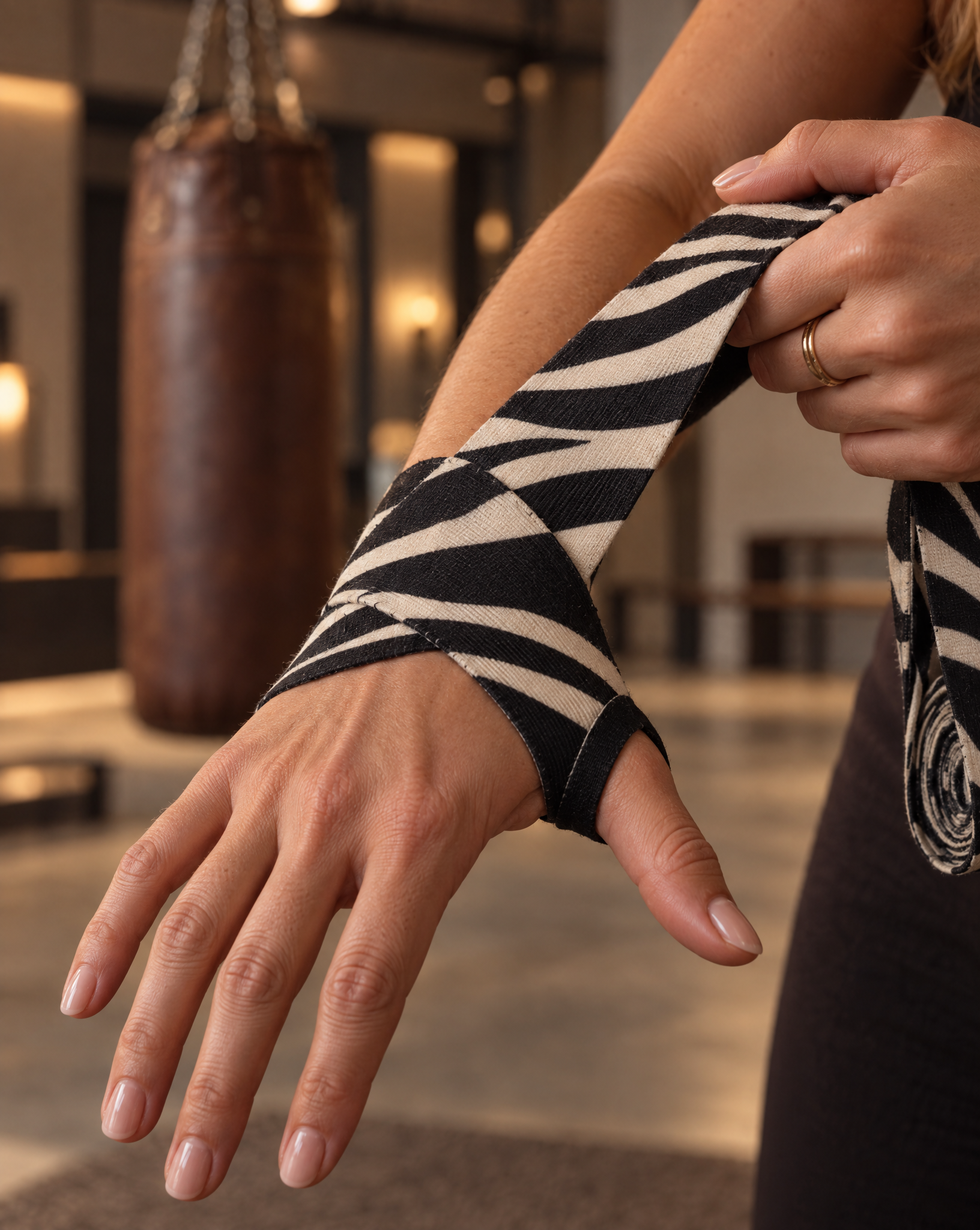
Slide your thumb through the loop and lay the wrap over the back of your hand. Many wraps have a "this side down" label: follow it, or the velcro ends up on the wrong side.
Step 2: over your knuckles
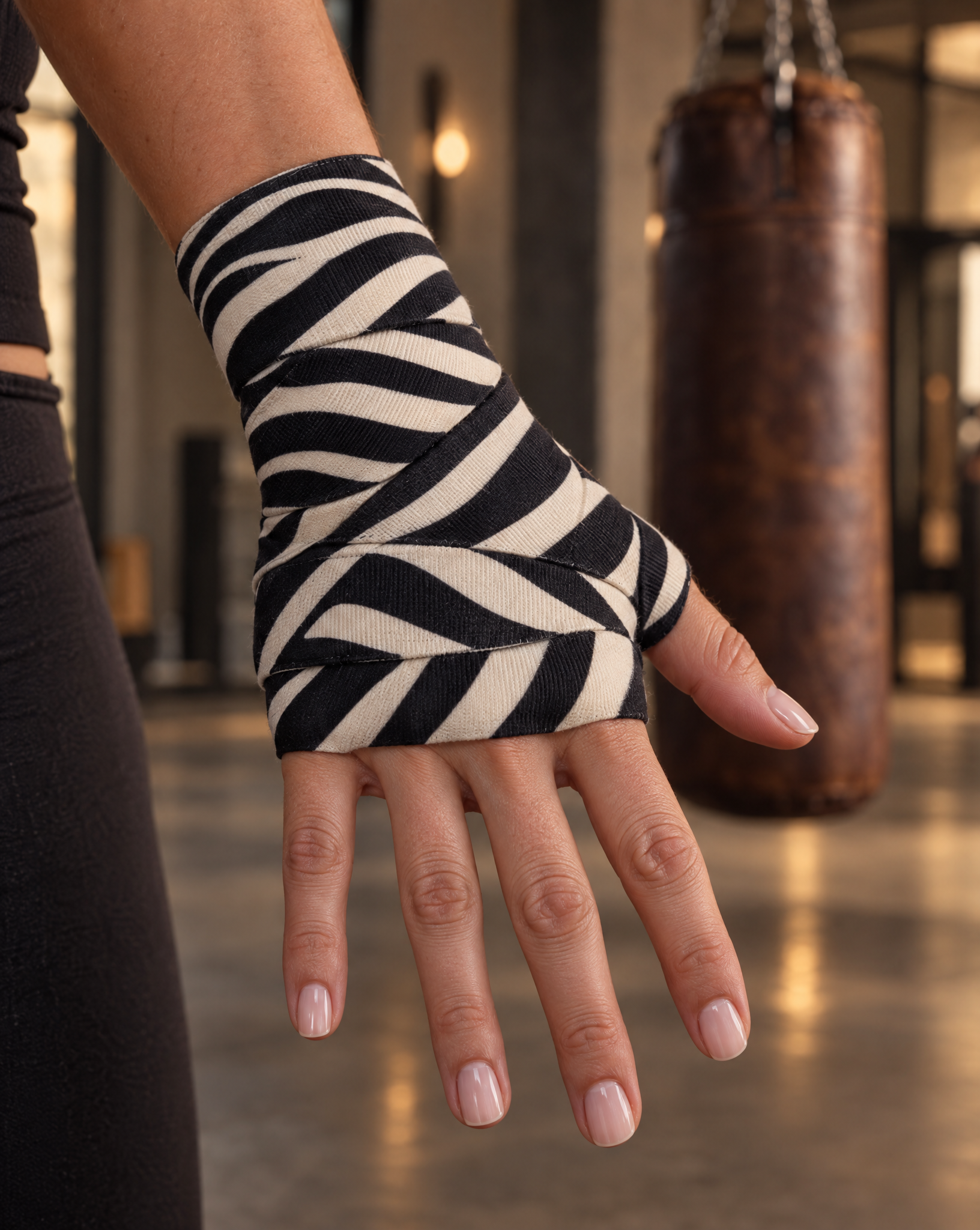
Wrap two to three times over your knuckles, just below your fingertips. Hand flat, fingers lightly spread. This is the layer that takes most of the impact later.
Step 3: between your fingers
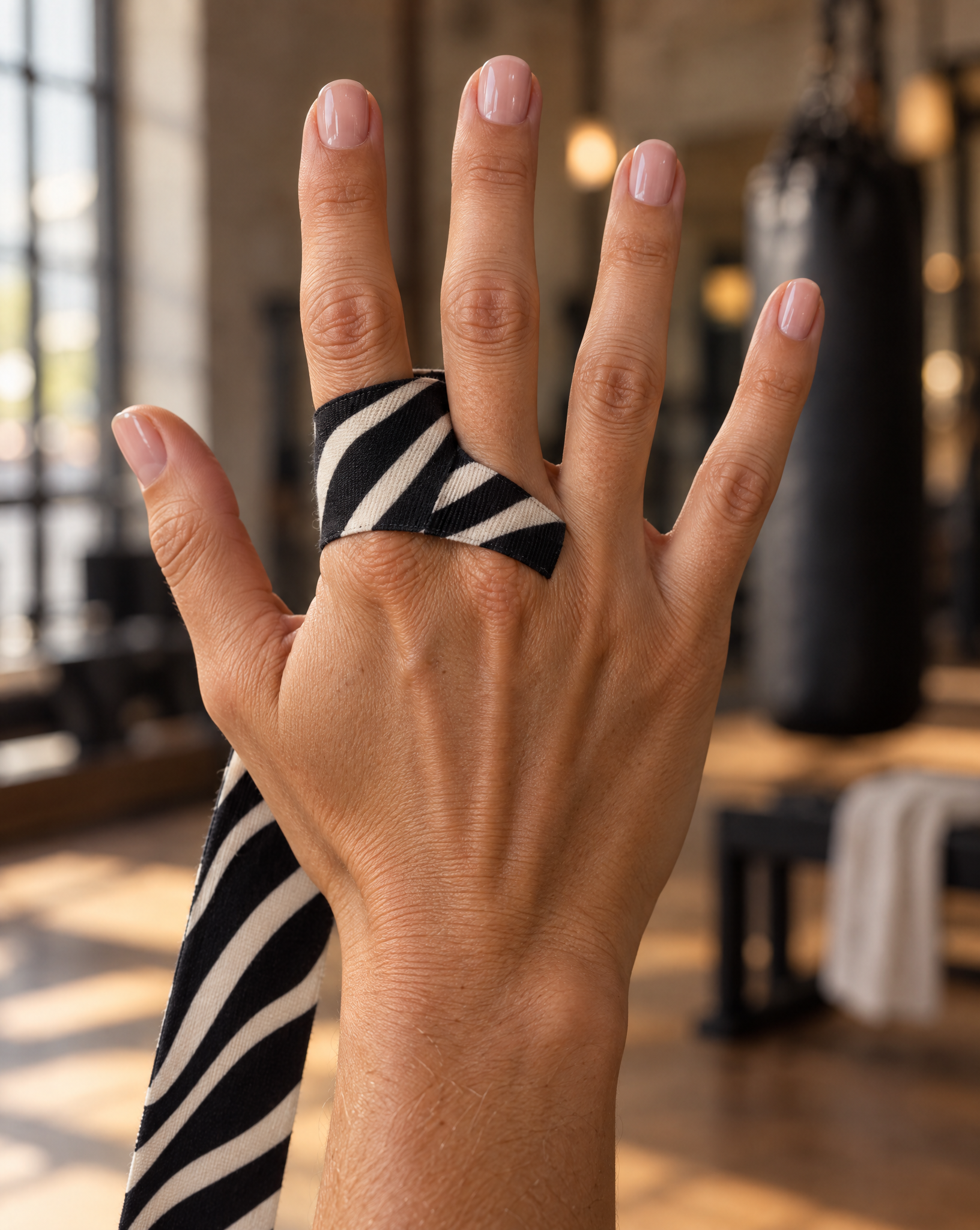
Weave the wrap between your fingers and back across your palm. The first time this feels clumsy, like solving a puzzle with one hand. After a few sessions you do it without thinking.
Step 4: wrist in a figure eight
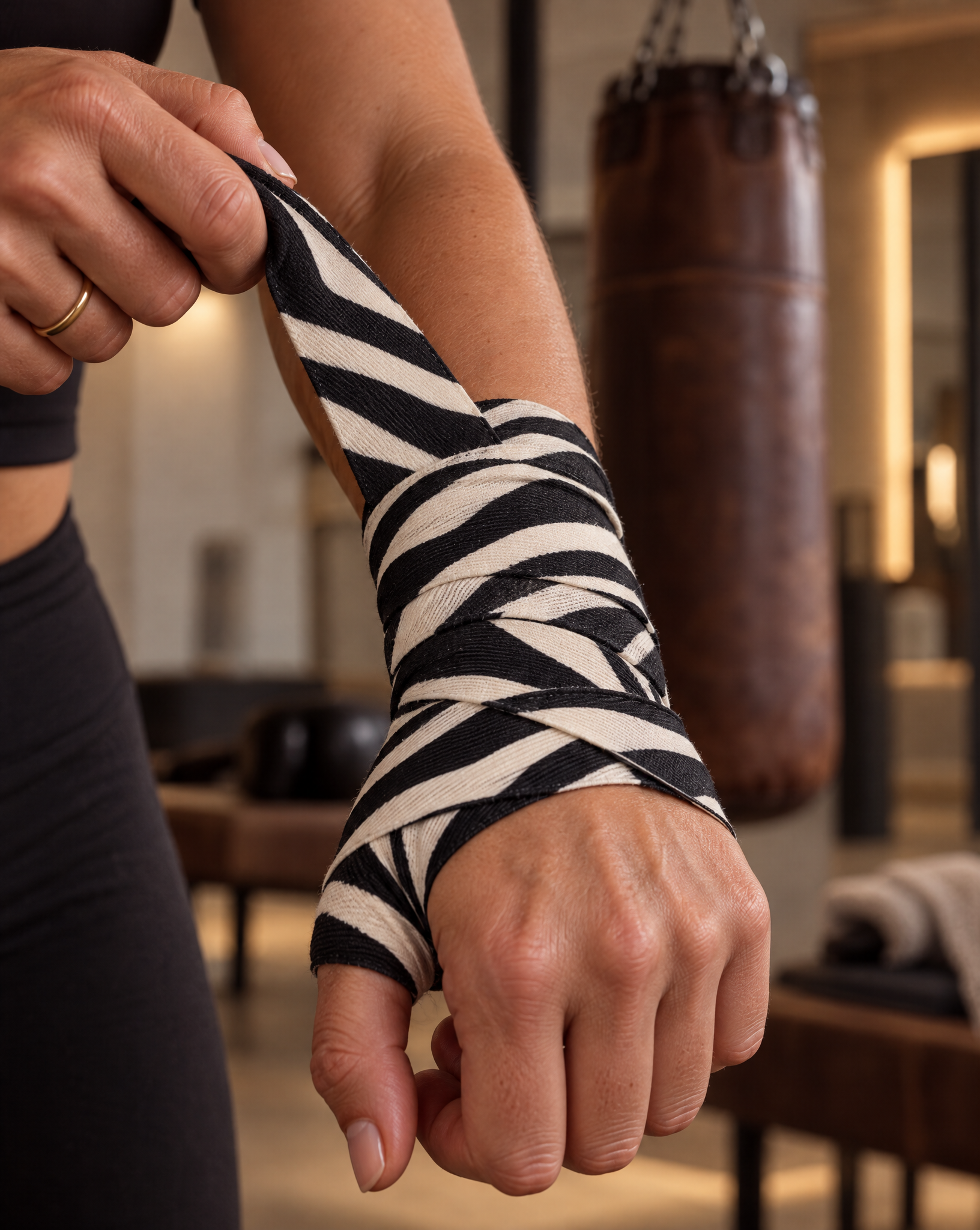
Go back to your wrist and wrap in a figure eight: two to three crossings over the back of your hand and around your wrist. This is your foundation. A floppy wrist wrap can't be adjusted later.
Step 5: lock it off
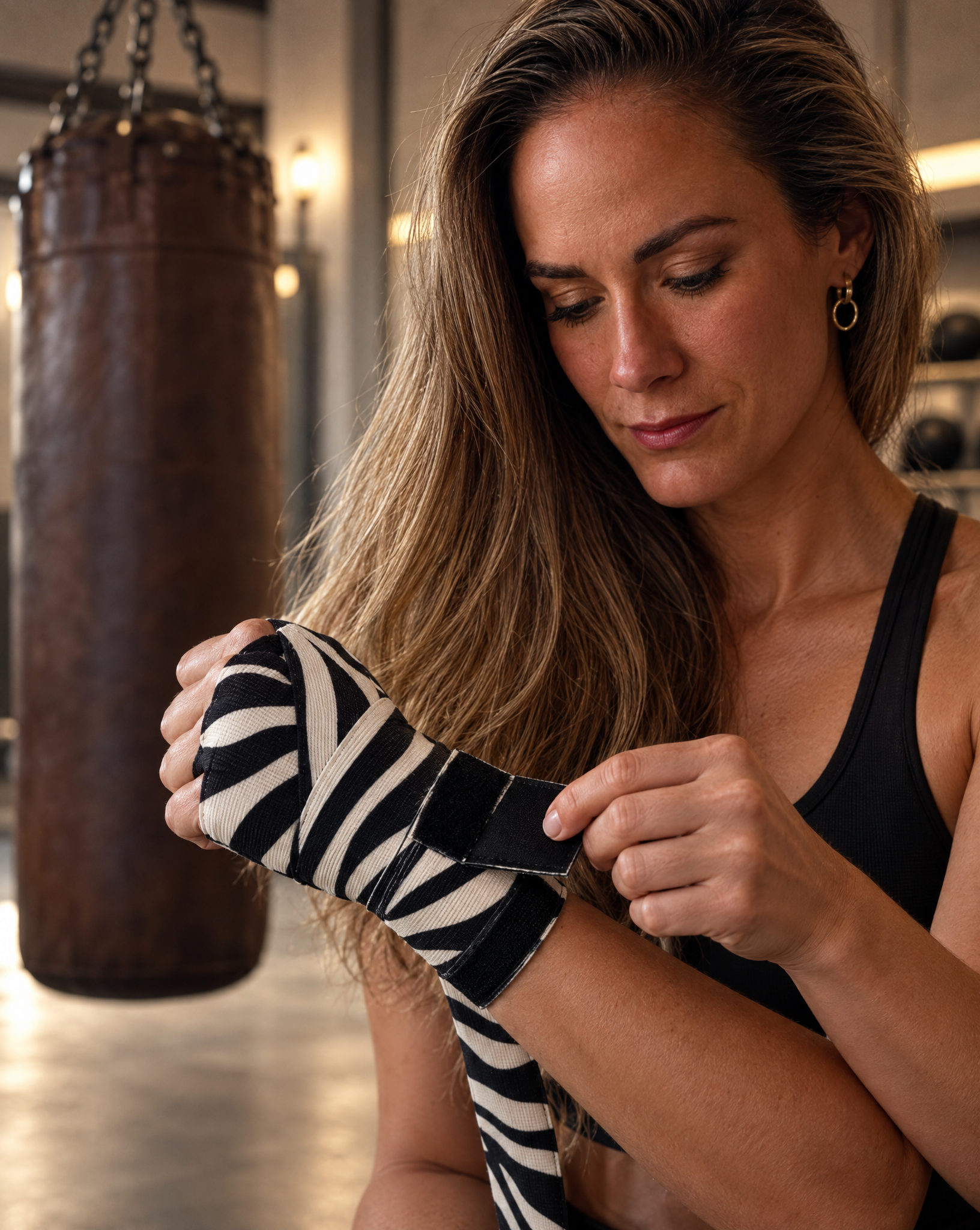
Wrap the last stretch around your wrist and close the velcro neatly, without crooked edges. Make a fist. Does it feel compact and solid, without tingling fingers? Then it sits right.
How to check that your wrap sits right
A good wrap feels compact when you make a fist, not trapped.
- Making a fist feels solid, your fingers still move normally
- No tingling or discoloured fingers
- Your wrist can't fold sideways
- Nothing shifts when you open and close your hand
- The velcro sits on your wrist, not halfway across your palm
Fingers tingling or nails turning white? Too tight, redo the last rounds. Fabric shifting the moment you pull on your glove? Too loose, start with a bit more tension at step 2.
The most common mistake
Using all your fabric on your knuckles and forgetting your wrist. A shame, because your wrist takes a lot when a punch doesn't land completely straight. Divide your wrap on purpose: wrist first, then knuckles, then fingers, then back to your wrist to finish.
Wash your wraps, or your gym bag starts to smell like a problem
Wash your wraps at 30 degrees in a laundry bag, and let them dry hanging up.
- Machine wash at 30 degrees, in a laundry bag like The WashGuard, otherwise you end up with a tangled ball of wrap
- Fold the velcro shut before washing, or it bites into the rest of your laundry
- No fabric softener, it kills the elasticity
- Not in the dryer, hang them to dry so they keep their stretch
- Out of your bag right after training, wet wraps in a closed bag are a bacteria party
Training two to three times a week? Count on new wraps every four to six months, as soon as the stretch is gone or the velcro stops gripping. A second pair in stock is smart: then you always train with dry wraps while the other pair is in the wash.
Ready for the next step
Wraps on, gloves on. Still unsure about your size? Take the fit quiz and know in five questions which boxing glove fits you. Or browse the full range of hand wraps and pick the print that matches your gear. Want everything sorted at once, gloves and wraps together? The Burgundy starter set handles that in one go. 🥊
Frequently asked questions
How long should a hand wrap be?
For most women's hands 4.5 metres works best. Shorter wraps of around 2.5 metres are mainly suited to kids or very small hands.
How often should I wash my hand wraps?
Wash your wraps at least every two or three sessions, at 30 degrees in a laundry bag. More often if you sweat heavily or train daily.
Can I use inner gloves instead of wrapping?
For light technique work or a trial class, sure. For bagwork, pads and sparring a wrapped bandage gives more wrist support. You can read more in our blog hand wraps or inner gloves.
What if my fingers tingle while wrapping?
Then your wrap is too tight. Redo the last rounds and make a fist in between to check that you can still squeeze normally.
Have you got your technique down already, or are you still practising on the couch in front of the mirror? 😉